
The White House Is Reviewing an FDA Peptide Policy. Here’s What That Means
The White House Is Reviewing an FDA Peptide Policy. Here’s What That Means.
For current status, see The Road to Legal Peptide Compounding: Where BPC-157 and Others Stand Today.
The short version: The Food and Drug Administration (FDA) has drafted a temporary policy that may allow pharmacies to compound certain peptides. It’s under White House review. Nobody outside government has seen it, and nothing has changed yet. Whether you’re a patient, a nurse or a physician, here’s what’s known and what isn’t.
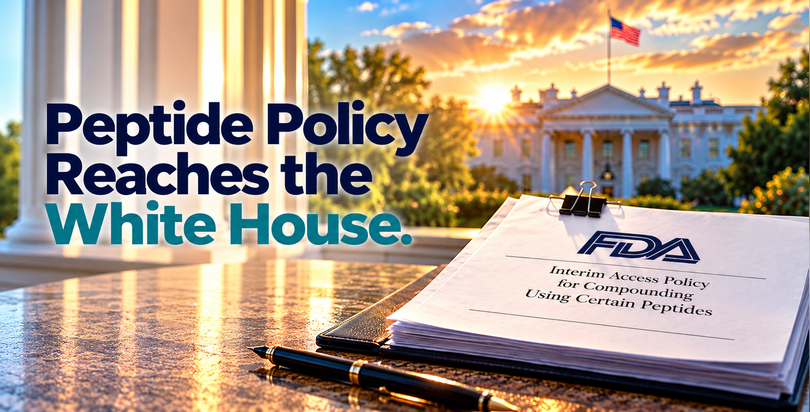
On October 15, 2026, the Department of Health and Human Services (HHS) and FDA submitted a policy titled “Interim Access Policy for Compounding Using Certain Peptides” to the White House Office of Management and Budget (OMB) for review. The public filing lists only the title. It doesn’t say which peptides are covered, what conditions apply, or when the policy would take effect.
A few terms, in plain English
making a medication from raw ingredients, rather than buying a finished drug from a drug manufacturer.
a state-licensed pharmacy that compounds medications for individual patients with a prescription.
a facility registered with and inspected by FDA that makes larger batches of compounded medications, often supplied to clinics as office stock.
FDA’s list of raw ingredients that compounders are allowed to use. 503A and 503B each have their own list.
when FDA says it won’t take action against something if certain conditions are met, without changing the law itself.
What’s been reported
- The Associated Press, citing two people familiar with the plan, reported that the policy would let pharmacies temporarily compound some of the most popular peptides, including BPC-157. No other peptide has been named publicly.
- Trade press described it as a possible temporary pathway for state-licensed (503A) pharmacies to compound peptides that aren’t currently allowed.
- It’s expected to work as enforcement discretion: FDA would say it won’t take action if pharmacies meet certain conditions, rather than changing the law.
None of this has been confirmed by a published policy. HHS had not commented when it was first reported.
How it connects to the July vote
This appears to be FDA’s next step after its advisory committee, an outside panel of experts, recommended six peptides in July. An interim policy would be temporary. Adding the peptides to the 503A bulks list permanently still requires a proposed rule, public comment and a final rule. It isn’t clear whether that rulemaking will be pursued.
What we don’t know
The only confirmed fact is that a policy on this topic was sent to the White House for review.
Everything else is unknown, including:
- The requirements for compounding. What a pharmacy would have to meet to compound under the policy, such as ingredient sourcing, testing and quality standards
- Which peptides are included, beyond press reports naming BPC-157
- Who it applies to: 503A pharmacies only, or 503B outsourcing facilities as well
- When, or whether, it takes effect in its current form
What happens next
- White House review. OMB can clear the policy, send it back for changes, or hold it. No date is set.
- FDA publishes the policy. This is the first point at which anyone will know what it actually says.
- The policy takes effect. That may happen at publication or later.
- Rulemaking for any permanent change.
This is our best estimate of the path, not an official timeline. FDA hasn’t published a roadmap for this policy, and given the strong public and political attention, things may move faster or take a different route than usual. More information will follow, and we’ll keep you up to date as it does.
What this means today
Nothing has changed yet. Until the policy is published, nobody knows what it will require: what testing, what ingredient traceability, what batch sizes, or anything else.
For clinicians and practices: A pharmacy compounding these peptides today is doing so outside current federal regulations. It can’t rely on this policy, because the policy hasn’t been published or taken effect. It’s working without those rules and may face regulatory scrutiny, and that risk can extend to the practices that buy from it.
For patients: If you’re receiving or considering a peptide such as BPC-157, its legal status hasn’t changed. It’s reasonable to ask your provider where the product comes from and how it was made. Products sold online as “research use only” aren’t made or tested for use in people. Whether any treatment is right for you is a conversation for you and your provider.
When the policy is published, we’ll break down what it requires, and The Road to Legal Peptide Compounding will show the new status.
Where McGuff fits
McGuff Outsourcing Solutions (MOS) is an FDA-registered 503B outsourcing facility. We make medications for clinics and practices, not directly for patients, and we’re following this policy closely. Press reports point to state-licensed pharmacies, which suggests 503A only, but we won’t know until the policy is published. If it opens a lawful path for 503B outsourcing facilities, we’ll evaluate it the same way we evaluate every product. Until then, we won’t treat a policy under review as permission to compound.
Why we’re covering this
We don’t make claims about how well these peptides work. Whether a treatment is right for a patient is a decision for that patient and their clinician.
What we can speak to is how a drug is made. For a 503B, FDA decides what we can legally compound. Clinicians decide what’s right for each patient. Our job is everything in between: designing quality into the process from the start, sourcing raw materials from FDA-registered manufacturers, and testing every batch before it’s released, so the product is what the label says it is.
That way no one has to wonder whether the drug is what it says it is. With product from an unverified source, that question never fully goes away. With ours, the questions can stay where they belong: whether it’s the right drug for the patient, and how the patient responds to it.
A new policy could change what’s allowed quickly, and we want patients and clinicians alike to have a clear picture of where things stand when it does.
Current statusThe Road to Legal Peptide Compounding: Where BPC-157 and Others Stand TodaySources
McGuff Outsourcing Solutions is a DBA of McGuff Pharmaceuticals, Inc., an FDA-registered 503B outsourcing facility. Compounded drugs are not FDA approved. FDA approval applies to drugs reviewed through a New Drug Application (NDA) or Abbreviated New Drug Application (ANDA). Compounded drugs are regulated under a separate framework: 503A pharmacies are overseen primarily by state boards of pharmacy, and 503B outsourcing facilities register with FDA, are inspected by FDA and must follow CGMP requirements. FDA does not review compounded drugs for safety, effectiveness or quality before they reach patients. This article is for educational purposes only and is not medical or legal advice. Patients should talk with their healthcare provider about any treatment.