
Methylcobalamin and Light: What Happens After the Vial Leaves the Carton
Protecting Methylcobalamin From Light: From Our Facility to Your Patient
Most clinicians know methylcobalamin is light sensitive. Fewer realize it isn’t just sunlight.
Ordinary room lighting is enough to start breaking it down, and the longer a dose sits out, the more it can lose. That means the handling in the last few minutes before administration matters.
This article explains why methylcobalamin is so sensitive to light, what happens to the molecule when it degrades, how McGuff Outsourcing Solutions protects it through manufacturing and release, and the practical steps your team can take to protect it in the clinic.
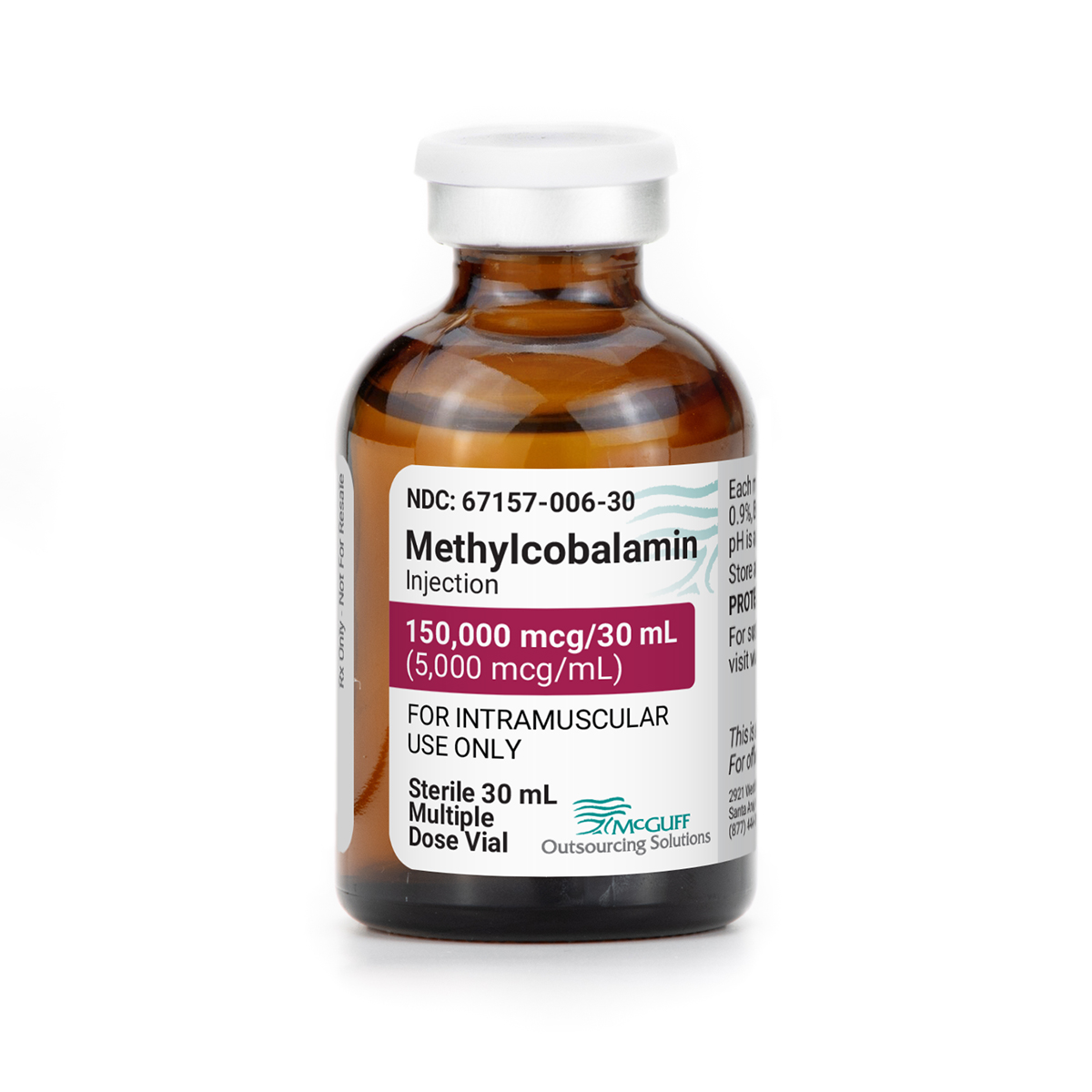
These recommendations apply to McGuff Outsourcing Solutions Methylcobalamin Injection, 5,000 mcg/mL, 30 mL multiple-dose vial, for intramuscular use.
Why methylcobalamin is so sensitive to light
The answer is one weak chemical bond. Methylcobalamin has a methyl group attached directly to its cobalt atom, and light can break that bond.
It also matters which light. Methylcobalamin absorbs both ultraviolet and visible light, so the overhead lights in a treatment room can drive degradation, not just sunlight.
What happens when it degrades
When that bond breaks, methylcobalamin converts mainly to hydroxocobalamin, a different form of vitamin B12. The result is less methylcobalamin in the dose than the label states.
Two things affect how fast this happens:
- Light. Brighter light and longer exposure mean more loss.
- Solution conditions. pH, oxygen and other formulation factors affect the rate.
Don’t rely on color to tell you. This product is normally red to dark red, and a dose can look normal and still have lost potency. Good handling is the real safeguard.
How we protect methylcobalamin before it reaches you
No single measure fully protects a molecule this sensitive. Our approach layers several controls, each covering a gap the others leave.
- Formulation. Our methylcobalamin is formulated with a controlled pH to support stability in solution.
- Low-actinic manufacturing. We compound, filter and fill methylcobalamin under low-actinic (yellow) lighting, which limits exposure to the wavelengths that drive degradation during production.
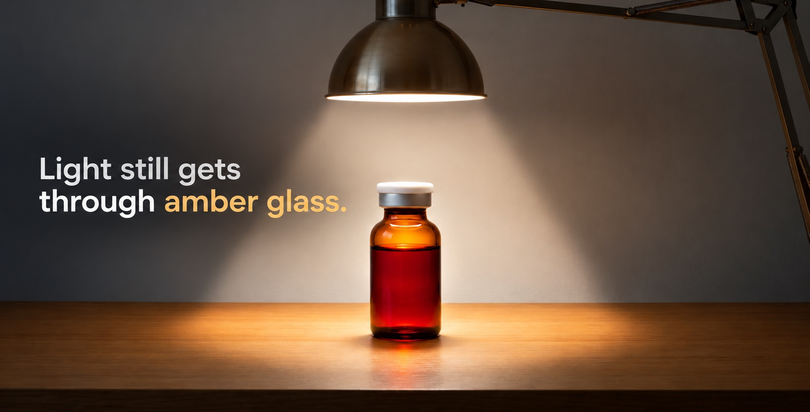
- Amber Type I glass vials. Amber glass filters out much of the ultraviolet and shorter-wavelength visible light that the molecule absorbs.
- Secondary carton. Amber glass does not block every wavelength methylcobalamin absorbs. The closed carton blocks the light that gets through the amber glass during shipping and storage, which is why keeping vials in the carton until use matters.
- Stability-indicating testing. Our quality control laboratory tests product using a stability-indicating HPLC method that separates methylcobalamin from hydroxocobalamin, its main degradation product. Along with assay, we evaluate color, clarity, pH and sub-visible particulates.
These controls are designed to deliver the product to your clinic as intended. Once the carton is opened, protecting it becomes a shared responsibility.
Protecting methylcobalamin in your clinic
The most important habit is simple: draw it up right before you give it, and give it promptly.
Minimizing unnecessary exposure to room light during preparation and handling can help reduce the potential for light-induced degradation and associated potency loss.
Storage
- Store at 20–25°C (68–77°F). Do not freeze.
- Keep vials in their closed carton whenever they’re not in use.
- Return multi-dose vials to the carton right after each use. Write the first-puncture date on the vial, and discard it 28 days after first puncture or at the expiration date, whichever comes first.
- Keep product away from windows and direct sunlight.
Preparation
- Use proper aseptic technique and draw up each dose immediately before administration.
- Avoid pre-drawing syringes at the start of the day or leaving prepared doses on a tray or counter.
- Prepare doses away from direct sunlight and bright procedure lights when possible.
Intramuscular injection
- Give it promptly after drawing it up.
- If a short delay can’t be avoided, keep the syringe covered and out of direct light. Covering it reduces light exposure, but it doesn’t make a long hold acceptable.
These steps help limit avoidable light exposure. They do not extend the labeled expiration date or the 28-day discard date. Always follow the product label and your facility’s procedures.
The takeaway
Methylcobalamin is light sensitive, and room light, not just sunlight, is enough to start breaking it down. We build protection in from formulation to the carton it ships in. The final few minutes before administration are in your hands, and they matter.
Keep it in the carton. Draw it up when you’re ready to give it. Give it promptly. Those small habits help make sure your patients get the dose you prescribed.
Questions about handling or storing our methylcobalamin? Contact McGuff and our team will be glad to help. 1 (800) 854-7220 · answers@mcguff.com
McGuff Pharmaceuticals, Inc., doing business as McGuff Outsourcing Solutions, is an FDA-registered 503B outsourcing facility. Compounded drugs are not FDA approved. FDA does not review their safety, effectiveness or quality before marketing. Outsourcing facilities are subject to current good manufacturing practice (CGMP) requirements. This article is for educational purposes for healthcare professionals and does not replace product labeling or clinical judgment.
Sources
Ip K, Banov D, Bassani G, Morgan L. Physicochemical stability of extemporaneously prepared methylcobalamin injections in the presence and absence of preservative and the impact of light exposure. International Journal of Pharmaceutical Compounding. 2019;23(2):167–175.
McGuff Outsourcing Solutions. Methylcobalamin Injection 5,000 mcg/mL, 30 mL multiple-dose vial: product specifications and handling information. mcguff503b.com.